Where the name XTherma comes from
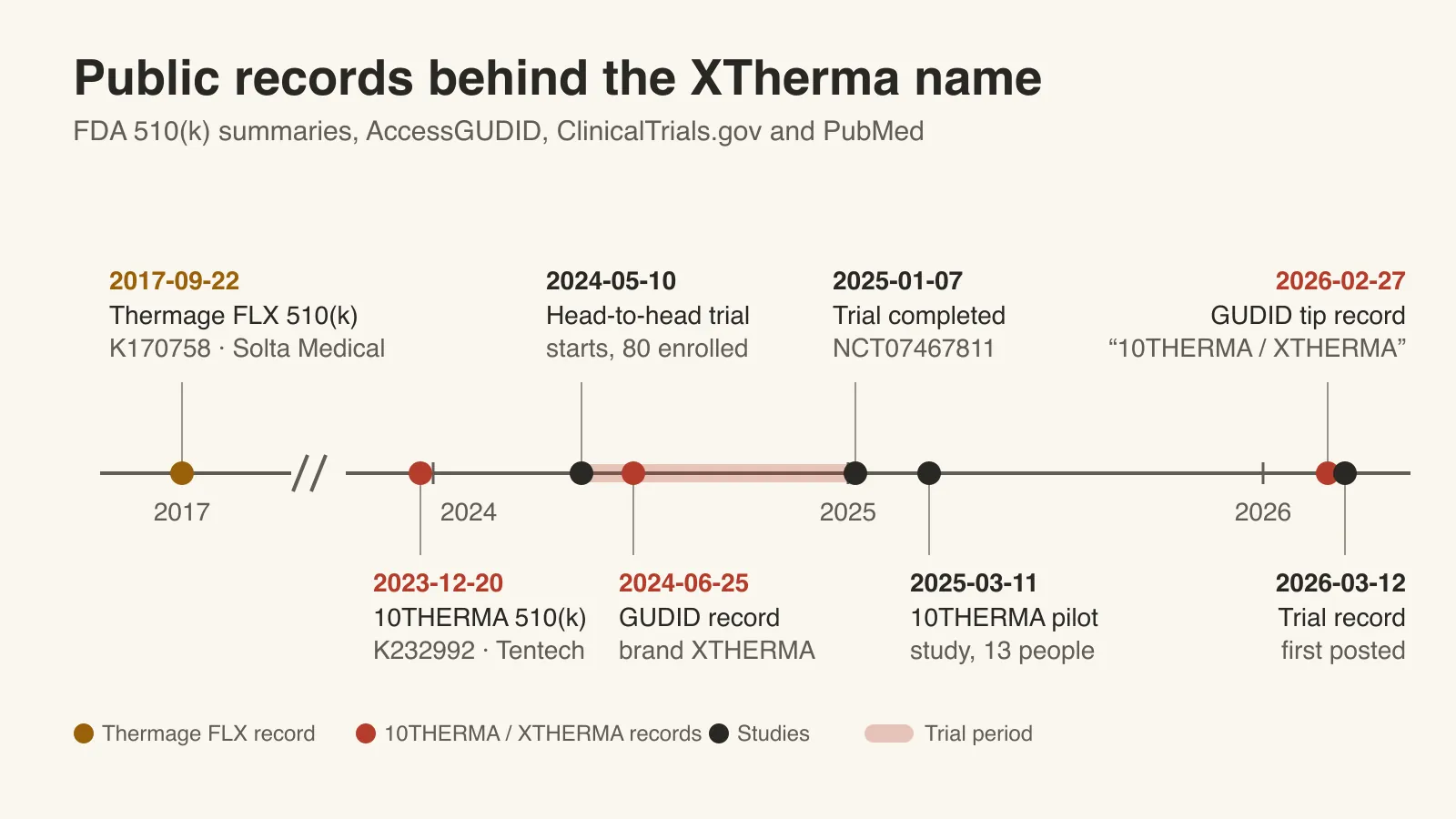
The US device-identifier database AccessGUDID holds a record for device identifier 08809709380466 with the brand name XTHERMA, model XTHERMA-H/P and company TENTECH Inc. Its device description begins "10THERMA is a High-Frequency Electrosurgical Unit (ESU)", and its premarket submission field reads K232992. The record was published on June 25, 2024. A second record, 08809709380510, published on February 27, 2026, gives the brand name as "10THERMA / XTHERMA" for a tip with model number TIP TMFT4.0-900/ XMFT4.0-900.
K232992 is the 510(k) record for 10THERMA, model TMSY02. Its submitter is Tentech Inc., with an address in Gangnam-gu, Seoul, and FDA's letter in the record is dated December 20, 2023. XTherma and 10THERMA therefore lead to the same record, and that record names a different company from Thermage FLX, which Solta Medical submitted under K170758 with a letter dated September 22, 2017.
What the two 510(k) summaries list side by side
The comparison table in the 10THERMA summary names the Thermage FLX System, K170758, as its primary predicate device. Its rows give the same entries for both: 6.78 MHz output frequency, a monopolar electrode, 400 W maximum average power, manual or footswitch operation and an LCD touchscreen interface. The Thermage FLX summary lists the same frequency, power and operating modes in its own table.
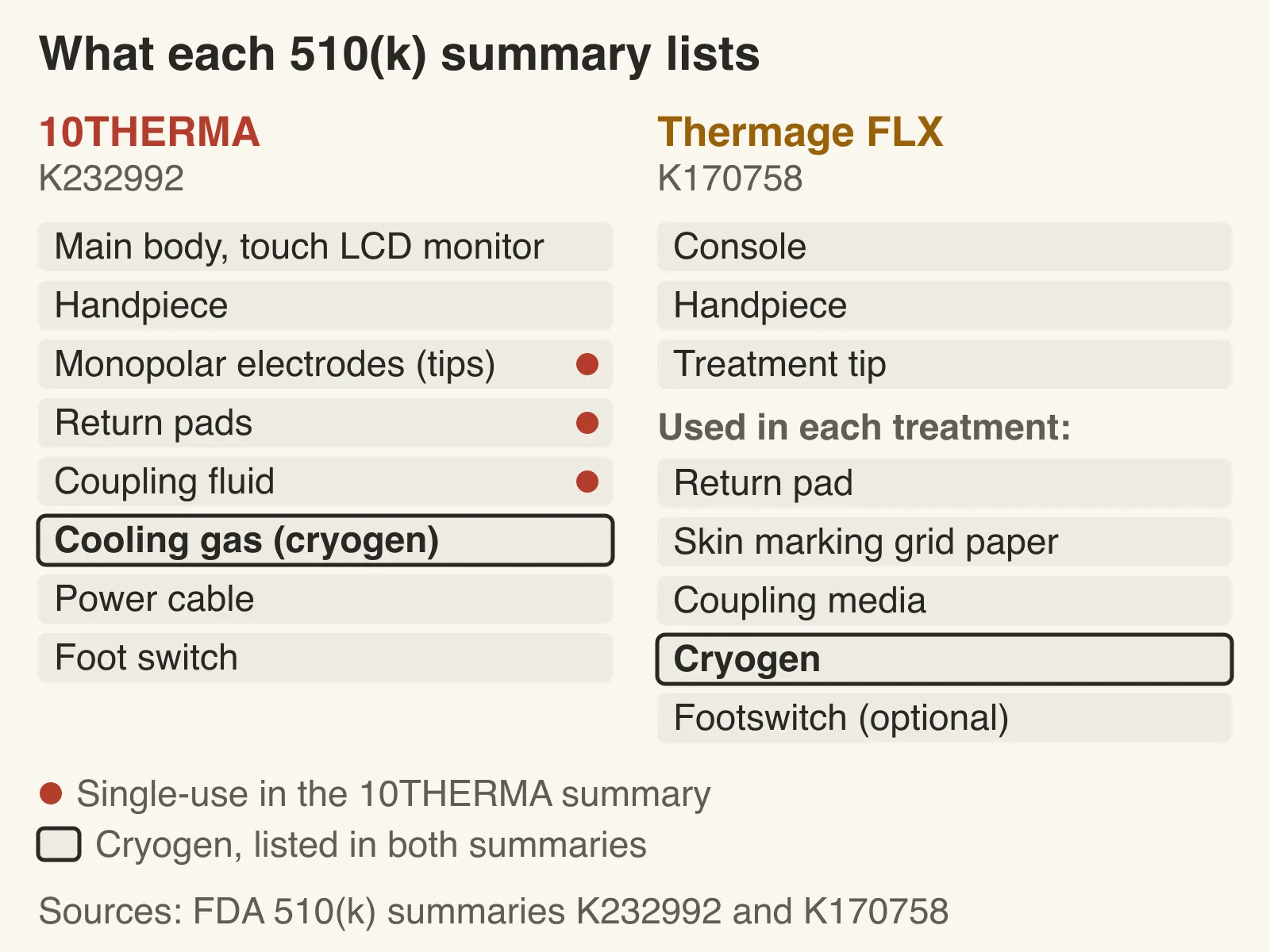
Both systems treat through a disposable tip with cryogen cooling. The 10THERMA summary lists a main body with a touch LCD monitor, a handpiece, monopolar electrodes (handpiece tips), return pads, coupling fluid, cooling gas (cryogen), a power cable and a foot switch, and names the electrodes, return pads and coupling fluid as single-use. The Thermage FLX summary lists a console, handpiece and treatment tip, with a return pad, skin marking grid paper, coupling media, cryogen and an optional footswitch used in each treatment, and describes RF energy delivered "while conductively cooling the epidermis".
What the two 510(k) summaries list
Both summaries describe nonclinical testing, such as electrical safety, software and biocompatibility. The 10THERMA summary adds: "No clinical studies were considered necessary and performed."
Why matching numbers do not make the same treatment
A shared frequency and power ceiling describe the generator, not what a person receives. In monopolar RF, current passes through the body from a single active electrode at the tip to a distant return electrode, and tissue resistance turns it into heat. The Thermage FLX summary describes RF tuning across a range of impedances, delivered "through single and multiple pass stamping motions of the tip".
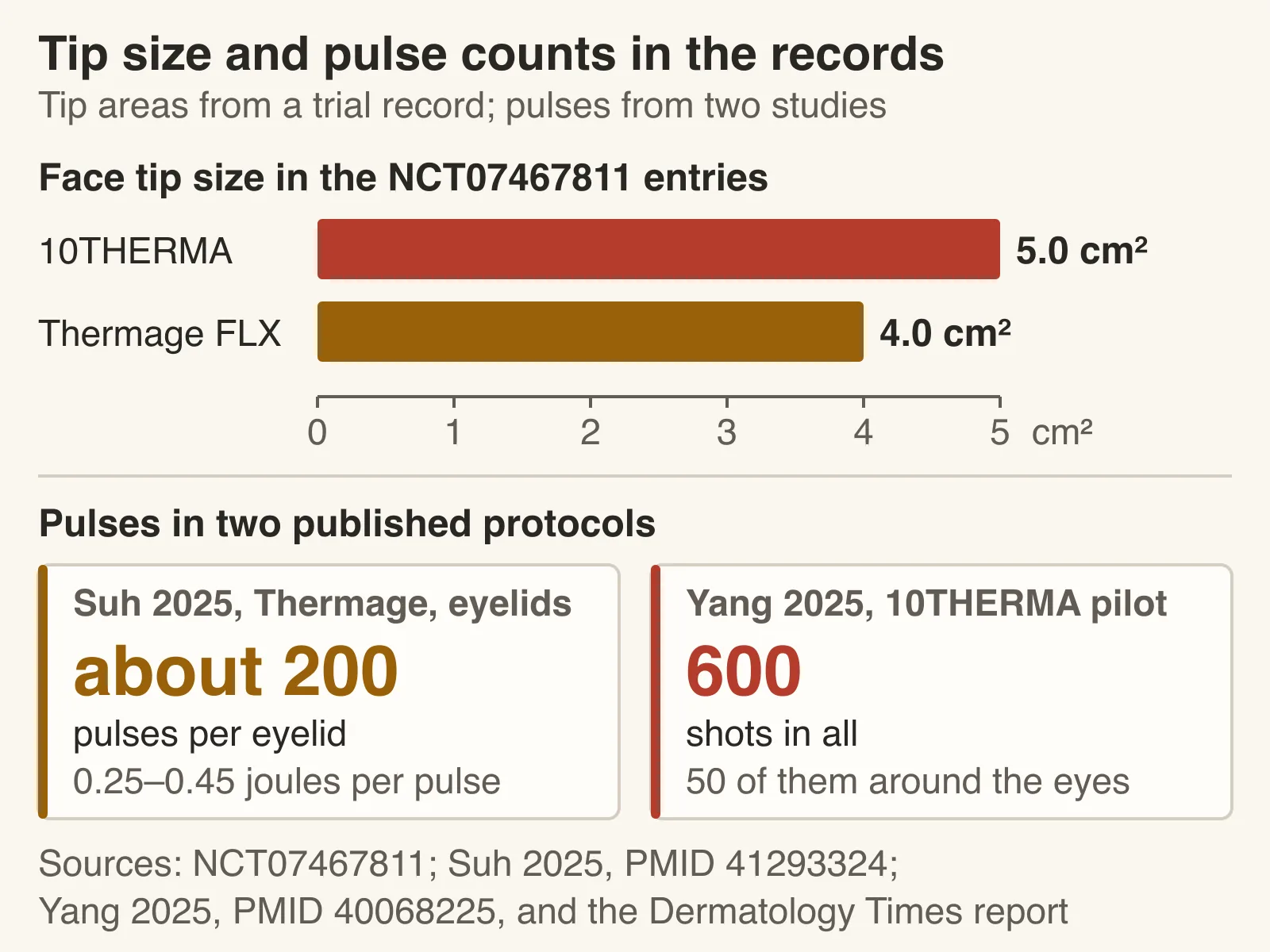
The tip and the plan change the treatment. In the registered head-to-head trial, the face tip size reads 5.0 cm² in the 10THERMA entry and 4.0 cm² in the Thermage FLX entry. Published protocols also specify energy and pulse counts: a Thermage eyelid study used 0.25–0.45 joules per pulse and about 200 pulses per eyelid, adjusted to tolerance, and a 10THERMA pilot study gave 600 shots, 50 of them around the eyes.
The trial that compared them directly
Tentech's ClinicalTrials.gov record NCT07467811 describes a multicenter, randomized noninferiority trial in which the participants did not know which device they received. It enrolled 80 adults aged 30 to 65 whose crow's feet and cheek lines scored 1 to 2 at entry, at Chung-Ang University Gwangmyeong Hospital, Severance Hospital and Asan Medical Center. One group was treated with 10THERMA and the other with Thermage FLX. Crow's feet and cheek lines were scored on 0-to-4 scales at baseline, week 4 and week 16: an independent evaluator used photographs of the treated area, and the examining investigator scored by direct observation.
How the head-to-head trial was set up
The trial started on May 10, 2024 and was completed on January 7, 2025. The record was first posted on March 12, 2026, and on October 24, 2026 it carried no results section, so the registry does not show how the two groups compared.
A separate 2025 multicenter pilot study treated 13 participants aged 35 to 62 once with a monopolar RF device with a 5 cm² tip; a Dermatology Times report of the paper identifies the device as 10THERMA at 6.78 MHz. Wrinkle scores around the eyes and on the cheeks were lower than at baseline at weeks 4 and 16, and no adverse events were observed during follow-up. The report lists the small sample, the lack of comparative devices and the use of the large 5 cm² tip on the eyelids as the study's limitations.
Questions to ask when XTherma is offered
- Which system is on the console: Thermage FLX, 10THERMA or XTherma, or another monopolar RF device?
- Which tip will be used, what is its area and pulse count, and can you see it unopened?
- How much energy per pulse, how many pulses and over which areas?
- Which studies does the clinic rely on for that device and that area?
For Thermage FLX, the guide to checking a genuine Thermage tip in Korea lists what to look at before the session. The Thermage and XERF record comparison reads another monopolar system's records the same way, and what Thermage is covers how the heating works. One Seoul clinic's device and tip notes name the Thermage FLX generation and tip it uses, and the guide to Thermage before-and-after studies covers when results were measured.
Common questions
- Which records carry the XTherma name?
- Two AccessGUDID device-identifier records: one lists the brand name XTHERMA, and a later record for a tip lists "10THERMA / XTHERMA". Both point to one 510(k), K232992, whose device name is 10THERMA and whose submitter is Tentech Inc.
- Is XTherma a version of Thermage FLX?
- No. Thermage FLX is the Solta Medical system recorded under K170758. The 10THERMA summary names Thermage FLX as the predicate device it was compared with and lists matching frequency and power entries, but 10THERMA is a separate product from a separate company.
- What should I check before an XTherma or Thermage session?
- Ask which system and tip will be used, the tip area and pulse count, the planned energy and treatment areas, and which studies the clinic relies on for that device. For Thermage FLX, ask to see the sealed tip before treatment starts.
Published references
- FDA 510(k) K232992: 10THERMA, letter, indications for use and 510(k) summary, letter dated December 20, 2023.
- FDA 510(k) K170758: Thermage FLX System, letter, indications for use and 510(k) summary, letter dated September 22, 2017.
- AccessGUDID device identifier 08809709380466: XTHERMA, TENTECH Inc., published June 25, 2024.
- AccessGUDID device identifier 08809709380510: 10THERMA / XTHERMA tip, published February 27, 2026.
- ClinicalTrials.gov NCT07467811: monopolar radiofrequency device for periorbital and cheek wrinkles, noninferiority trial, first posted March 12, 2026; checked October 24, 2026.
- Yang HJ, et al. A multicenter pilot study of the effectiveness and safety of a monopolar radiofrequency device for improving periorbital and facial fine wrinkles. Journal of Dermatological Treatment, 2025;36(1):2469633. PMID 40068225.
- Dermatology Times report on the Yang et al. pilot study, March 19, 2025.
- Suh DH, et al. A Deep Learning-Based Automated Scoring System for Predicting Eyelid Rejuvenation Outcomes After Monopolar Radiofrequency Treatment. Clinical, Cosmetic and Investigational Dermatology, 2025;18:3133-3138. PMID 41293324.