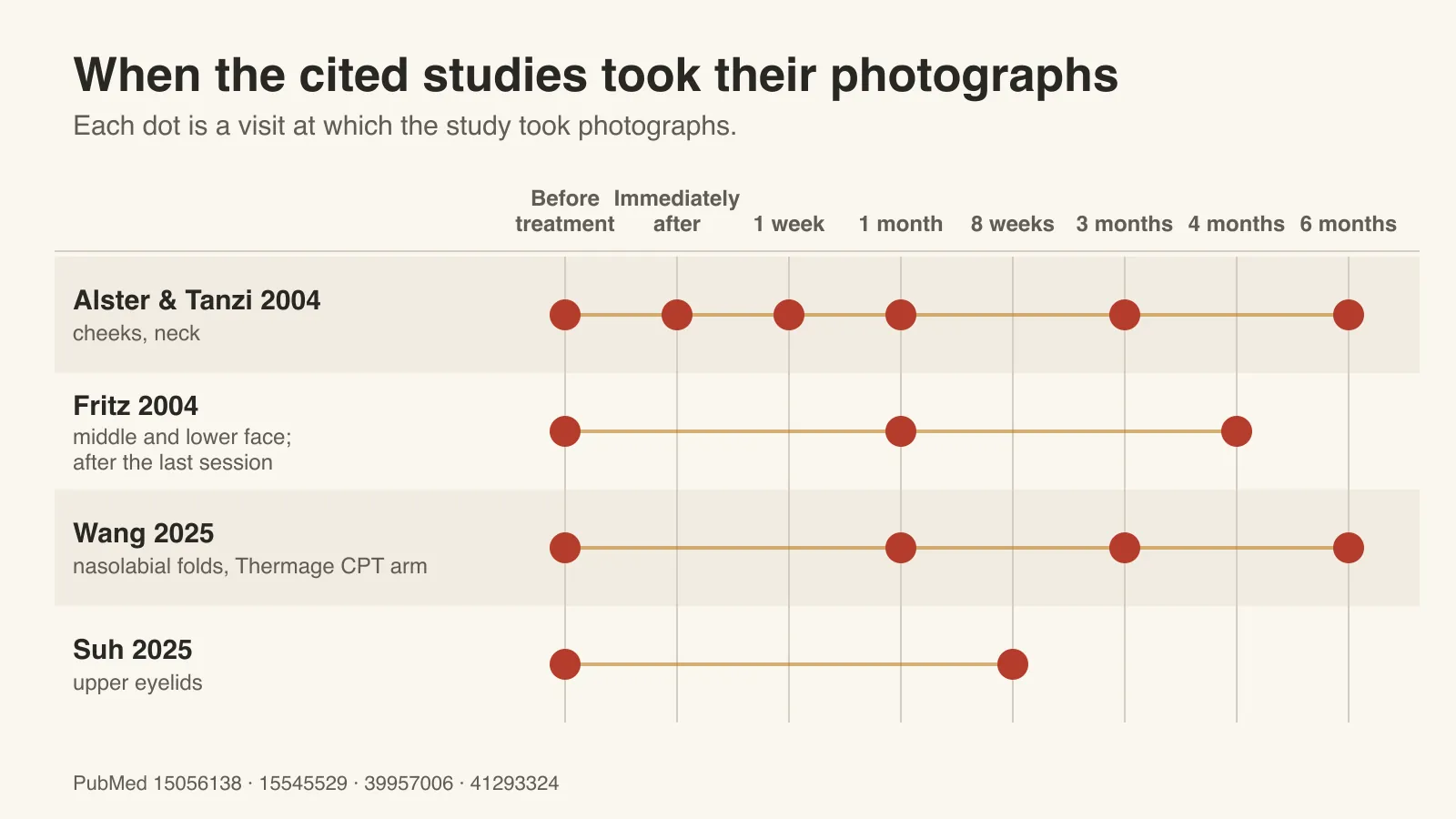
Where each study looked
Cheeks, jowls and neck: pictures at 1, 3, 4 and 6 months
Alster and Tanzi treated 50 people once with the ThermaCool system, an earlier Thermage generation: 30 for mild to moderate cheek laxity and 20 for the neck. The cheek treatment covered skin from the nasolabial folds out to the front of the ear and down to the jawline, and the neck treatment ran from the jaw to mid neck. Three masked assessors compared photographs taken at baseline, immediately after treatment, at 1 week and at 1, 3 and 6 months, on a quartile scale from under 25% to over 75% improvement. The authors reported improvement in most patients, with tightening still evident 6 months after the single treatment, and wrote that the longevity of results had yet to be determined.
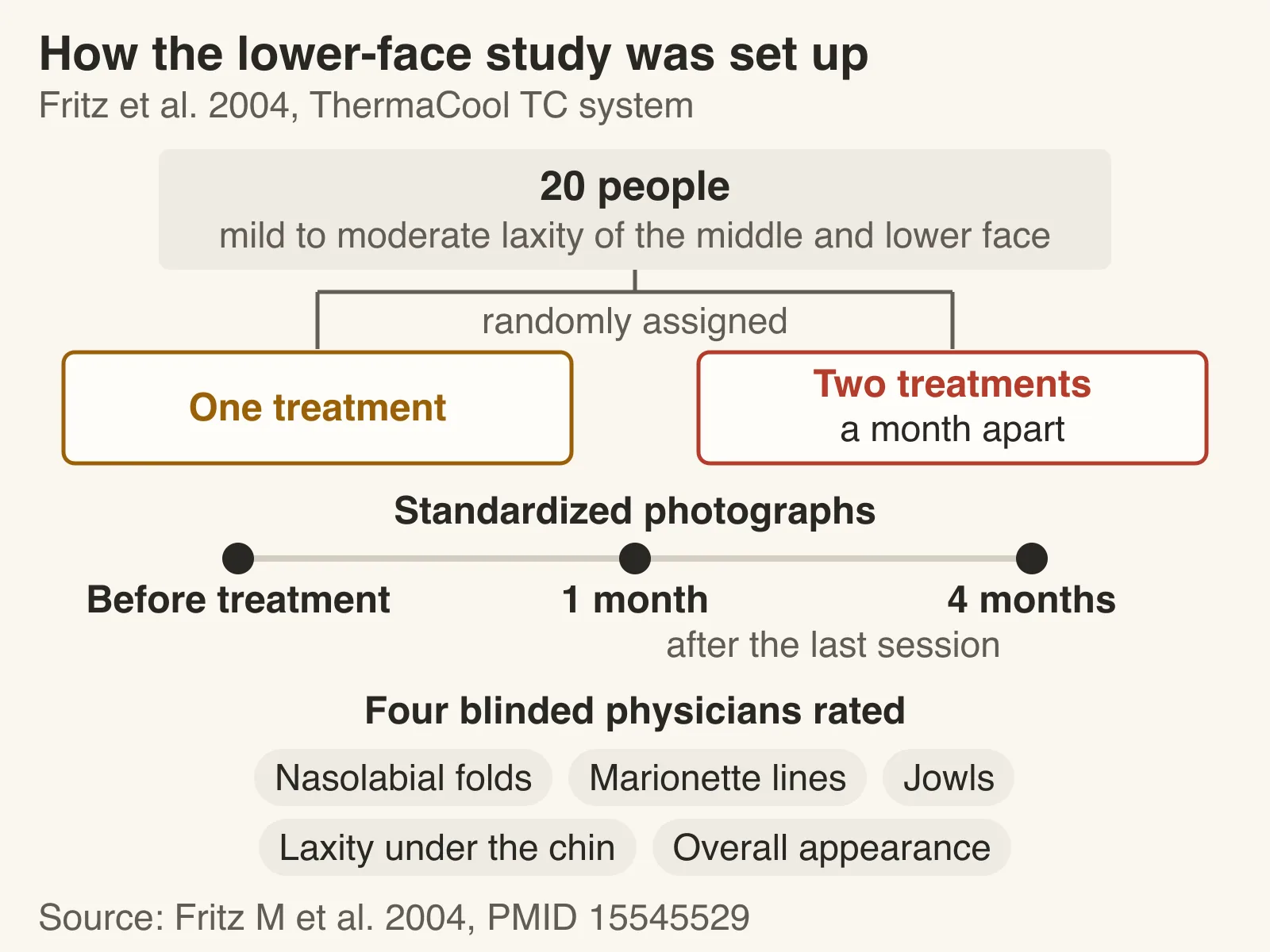
Fritz and colleagues randomly assigned 20 people with mild to moderate laxity of the middle and lower face to one ThermaCool TC treatment or two treatments a month apart. Four blinded physicians rated standardized photographs taken before treatment and 1 and 4 months after the last session, scoring the nasolabial folds, marionette lines, jowls, laxity under the chin and overall appearance. Both groups improved further between the 1-month and 4-month assessments, two treatments scored higher for the nasolabial folds, and the authors described the overall change as modest in most patients.
A 2019 split-face trial treated 20 people with monopolar capacitive radiofrequency on one side of the face and microfocused ultrasound on the other; its abstract names the technology rather than the device. Laxity scores for the face and upper neck had improved significantly on both sides by day 30 and remained improved through days 90 and 180. A 2025 randomized study from Beijing used Thermage CPT as the comparison arm for a different monopolar device and photographed its 40 participants, including with Antera 3D imaging, at baseline and at 1, 3 and 6 months, measuring the depression volume of the nasolabial folds.
Eyes and eyelids: from 8 weeks to 6 months
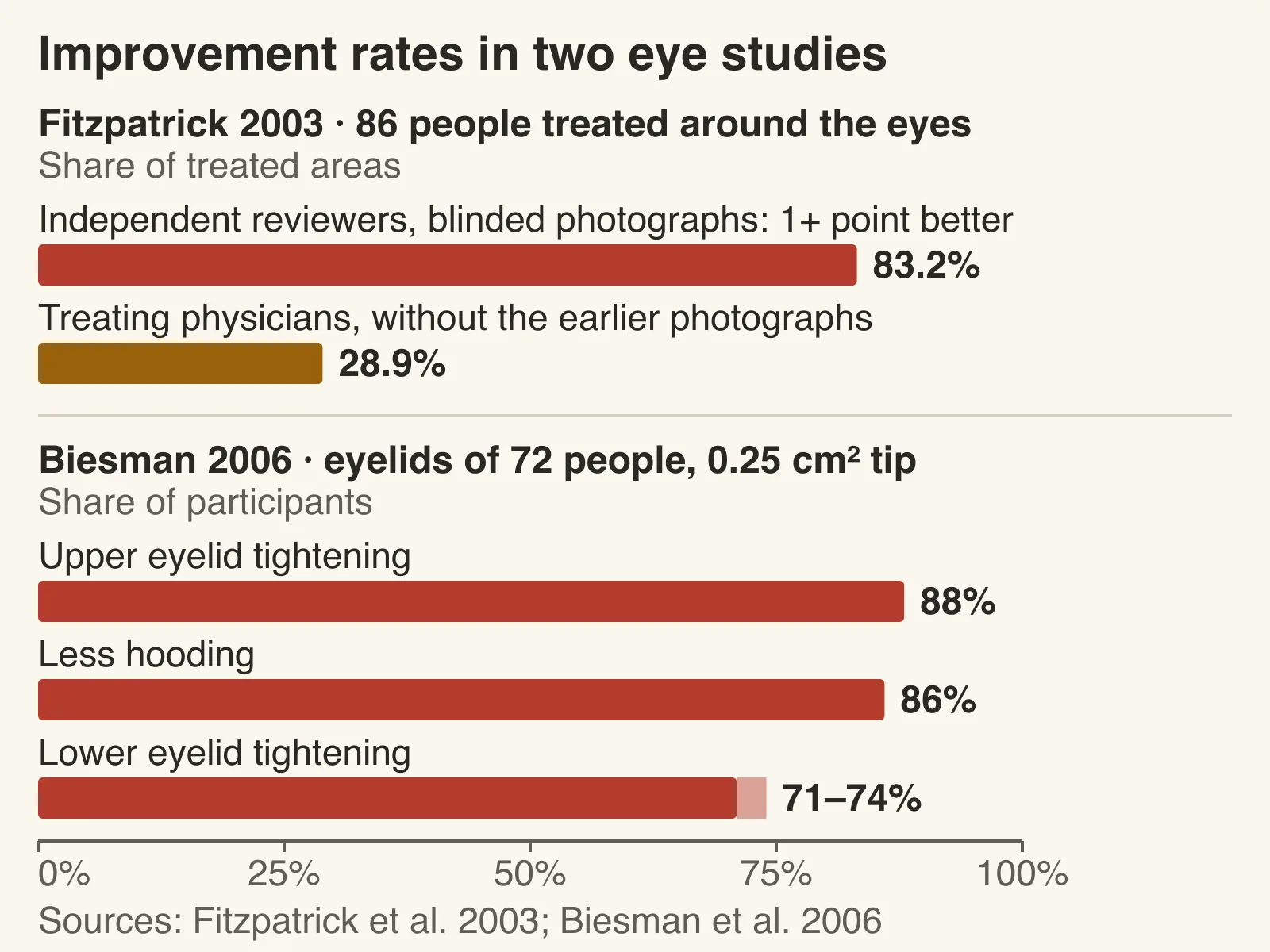
In Fitzpatrick's six-month study of 86 people treated around the eyes with the ThermaCool TC System, independent reviewers scoring blinded photographs found at least a one-point wrinkle-score improvement in 83.2% of treated areas, while treating physicians working without the pre-treatment photographs noted improvement in 28.9%.
Biesman and colleagues treated the eyelids of 72 people once with a 0.25 cm² monopolar RF tip and followed them on a serial basis for 6 months, with masked physician observers rating the photographs taken at each visit. Upper eyelid tightening and less hooding were noted in 88% and 86% of participants and lower eyelid tightening in 71–74%. Most achieved "at least up to 25% improvement", and a smaller share showed larger change.
A 2025 Korean study of 50 people treated the upper eyelids once with a Thermage 450 REP 0.25 cm² eye tip, at 0.25–0.45 joules per pulse and about 200 pulses per eyelid. Photographs were taken at baseline and at 8 weeks, an interval the authors chose to capture early change while noting that collagen remodeling can continue for 3–6 months. Five board-certified dermatologists rated each pair blind, and those ratings trained an automated scoring model. For the eye-specific procedure, see the Eye Thermage guide.
How to read a before-and-after pair
A before-and-after pair compresses months into two frames. Between them, the cited studies held five things constant: a set interval after treatment; the lighting, which was cross-polarized in the eyelid scoring study; a fixed distance with identical aperture, exposure and ISO; a neutral expression with the eyes in primary gaze; and raters who were masked or blinded. The gap between blinded photo reviewers and treating physicians in the periorbital study shows how far the rating method can move the result.
Five things the studies kept the same
A photograph you take before your session is most useful if you can repeat it the same way at the later visit. In the lower-face study, every participant had mild swelling and mild to moderate redness right after treatment; the aftercare and downtime guide covers those first days.
Questions for clinic photographs
Delight Dermatology Clinic's before-and-after photographs show one pair from a combined plan that also included Ultherapy. When a clinic shows you a pair, ask:
- Which device, tip and areas were treated, and was anything else part of the plan?
- How long after treatment was the second photograph taken?
- Were both photographs taken with the same light, distance, camera settings and expression?
Who tends to suit the treatment is covered in the candidates guide, and the XTherma and Thermage records guide explains how to confirm which device a clinic is offering.
Common questions
- When did studies check Thermage results?
- The cited studies rated photographs taken from immediately after treatment to 6 months later, at visits that included 1 week, 8 weeks and 1, 3, 4 and 6 months. One lower-face study found further improvement between the 1-month and 4-month visits, and a cheek-and-neck study still saw tightening at 6 months.
- Have studies measured Thermage on the neck?
- Yes. Alster and Tanzi treated 20 people for neck laxity, from the jaw to mid neck, and rated photographs at 1, 3 and 6 months. A 2019 split-face trial of monopolar capacitive radiofrequency assessed the face and upper neck at days 30, 90 and 180.
- Why do before-and-after photos of the same treatment look so different?
- The interval, lighting, distance, camera settings, expression and the person rating the pictures all change what a pair shows. In one periorbital study, blinded photo reviewers and treating physicians without the earlier photographs reached very different improvement rates.
Published references
- Alster TS, Tanzi E. Improvement of neck and cheek laxity with a nonablative radiofrequency device: a lifting experience. Dermatologic Surgery, 2004;30(4 Pt 1):503-507. PMID 15056138.
- Fritz M, et al. Radiofrequency treatment for middle and lower face laxity. Archives of Facial Plastic Surgery, 2004;6(6):370-373. PMID 15545529.
- Alhaddad M, et al. A randomized, split-face, evaluator-blind clinical trial comparing monopolar radiofrequency versus microfocused ultrasound with visualization for lifting and tightening of the face and upper neck. Dermatologic Surgery, 2019;45(1):131-139. PMID 30531187.
- Wang Z, et al. Long-term efficacy and safety of a novel monopolar radiofrequency device for skin tightening: a prospective randomized controlled study. Lasers in Surgery and Medicine, 2025;57(3):259-264. PMID 39957006.
- Fitzpatrick R, et al. Multicenter study of noninvasive radiofrequency for periorbital tissue tightening. Lasers in Surgery and Medicine, 2003;33(4):232-242. PMID 14571447.
- Biesman BS, et al. Monopolar radiofrequency treatment of human eyelids: a prospective, multicenter, efficacy trial. Lasers in Surgery and Medicine, 2006;38(10):890-898. PMID 17163476.
- Suh DH, et al. A deep learning-based automated scoring system for predicting eyelid rejuvenation outcomes after monopolar radiofrequency treatment. Clinical, Cosmetic and Investigational Dermatology, 2025;18:3133-3138. PMID 41293324.
- FDA 510(k) K170758: Thermage FLX System, letter, indications for use and 510(k) summary, letter dated September 22, 2017.
- ClinicalTrials.gov NCT07467811, first posted March 12, 2026; checked October 24, 2026.