Thermage vs XERF: What US Records Actually Show
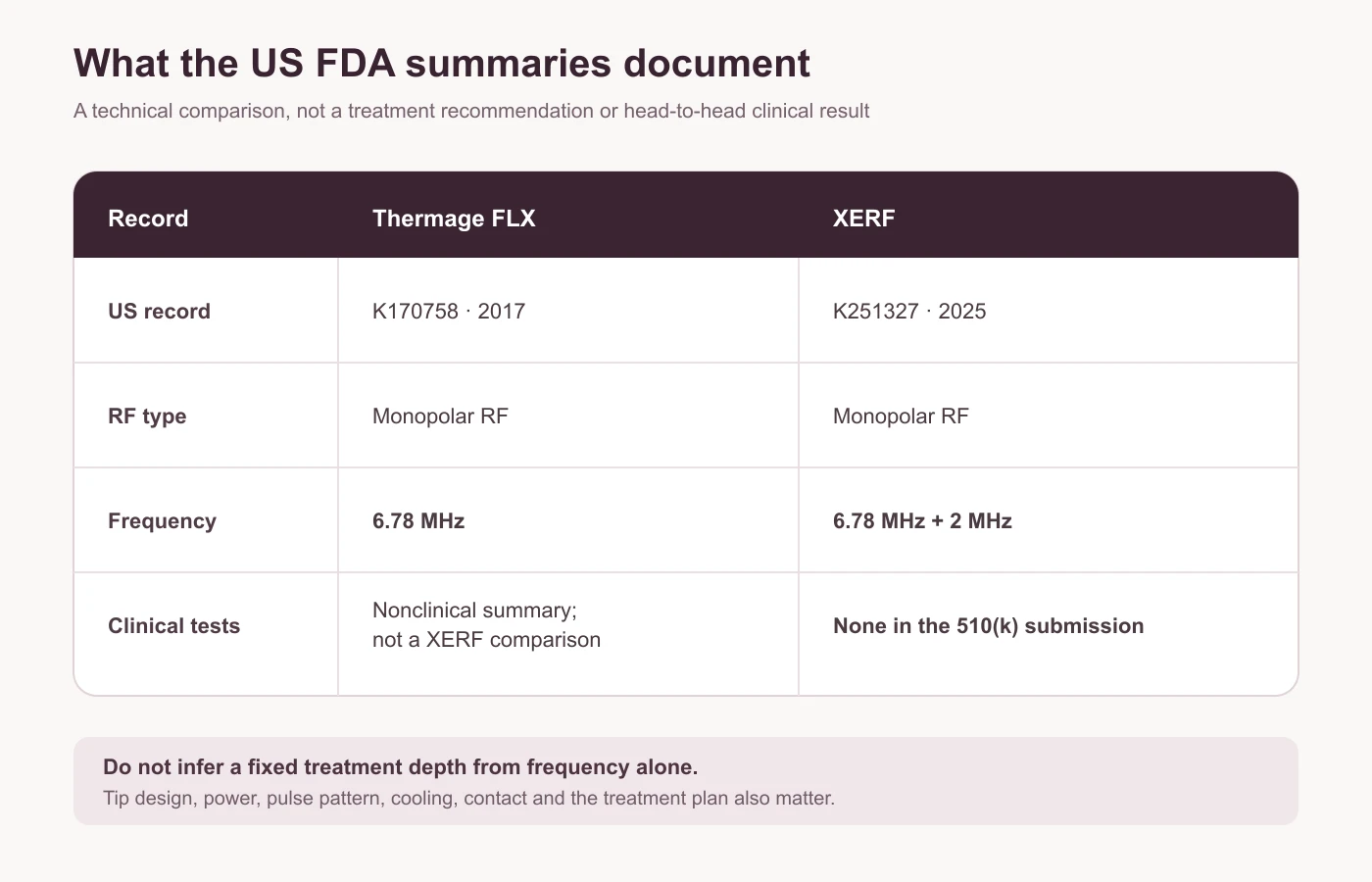
Written by Delight Dermatology editorial team · Editorially updatedThermage FLX and XERF are both monopolar radiofrequency systems, but their public US records are not interchangeable. Thermage FLX's K170758 summary lists 6.78 MHz and includes non-invasive wrinkle indications. XERF's K251327 summary lists 6.78 MHz and 2 MHz, while its indication is limited to electrocoagulation and hemostasis. The XERF 510(k) included no clinical tests, and an open FDA Class II recall currently applies to specified EFFECTOR 60 units. These facts do not establish which system would produce a better cosmetic result for one person.
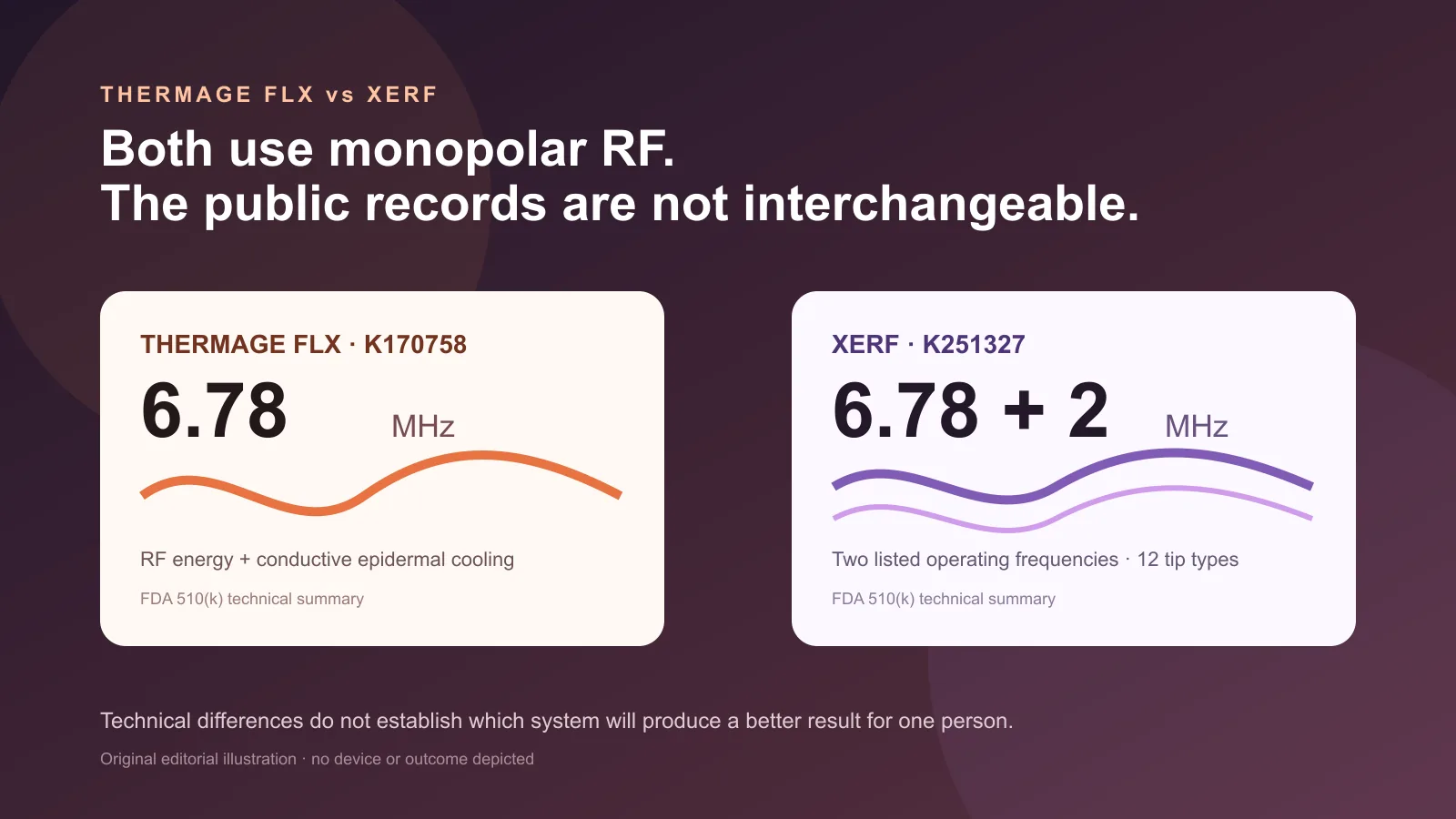
A useful comparison starts with the exact documents, then separates what those documents show from what they leave unanswered. Frequency, tip design, power, pulse pattern, cooling, skin contact and the treatment plan all affect energy delivery. A label such as "dual frequency" cannot by itself tell a patient the treatment depth, comfort or likely result.
Documented technical differences
FDA's K170758 Thermage FLX summary describes a 6.78 MHz monopolar RF system. It says the system delivers RF energy while conductively cooling the epidermis, monitors skin contact and tunes energy across a range of impedances. Its listed components include the console, handpiece, treatment tip and return pad.
FDA's K251327 XERF summary describes a monopolar RF system with 2 MHz and 6.78 MHz output, 12 active electrode-tip types and a return pad. Its comparison table names Thermage FLX as the predicate device and truSculpt iD as a reference device. That predicate relationship is regulatory context, not a finding that the two systems have the same settings or cosmetic outcomes.
The US indications are not the same
K170758 lists Thermage FLX's RF-only components for dermatologic and general surgical electrocoagulation and hemostasis, non-invasive treatment of periorbital wrinkles and rhytids including the upper and lower eyelids, and non-invasive treatment of wrinkles and rhytids. The summary contains additional indications for simultaneous RF and vibration.
K251327 gives XERF one indication: dermatologic and general surgical procedures for electrocoagulation and hemostasis. The record does not list skin tightening, facial lifting or wrinkle treatment as a US indication. Calling the device "FDA-cleared for skin tightening" would therefore exceed the cited 510(k). This is a statement about the wording of that US record; it does not determine authorization or permitted claims in Korea.
What 510(k) substantial equivalence does not prove
A 510(k) decision means FDA found the device substantially equivalent to legally marketed predicates for the stated purpose. It is not premarket approval and is not a superiority award. K251327 says no clinical tests were included in the submission. Its performance section summarizes electrical, software, biocompatibility and thermal testing, including ex vivo tissue work and a comparison of temperature-time curves at 3 mm under standardized conditions.
That nonclinical comparison does not tell a prospective patient that XERF and Thermage will produce equal results, or that one will be deeper, safer, more comfortable or longer lasting. It also does not compare individual treatment plans, operators or patient anatomy.
What later XERF studies add—and what they do not
A 2025 computational and histologic study compared 6.78 MHz, 2 MHz and sequential dual-frequency RF using modeling and porcine tissue. Several authors listed affiliations with Cynosure Lutronic. The work can inform a mechanism hypothesis, but animal tissue and computer models do not establish human cosmetic superiority over Thermage.
A 2026 prospective multicenter study followed 39 subjects who received two dual-frequency RF sessions and reported short-term assessments at 30 and 90 days. Cynosure Lutronic provided the device, consumables and a modest research grant. The study had no Thermage arm and does not establish a one-session comparison, relative durability or which system is better for an individual. Its authors concluded that the approach supports further evaluation.
Current FDA recall: check the exact unit
The official FDA recall record identifies catalog numbers 1101210000, 1101210100 and 1101210200, with serial or lot identifiers MP60J25C02, MP60J25G05, MP60J25G06, MP60J25H03 and MP60J25H01. It covers units manufactured from April 1 through August 20, 2025. The record lists worldwide distribution including South Korea.
FDA records the manufacturer's reason as manufacturing defects in that date range that can, on rare occasions, result in adverse events. The action entry says an urgent field-safety notice titled "XERF Tips" told consignees to stop using affected devices and return all affected units. The record was last updated October 5, 2026 and says the recall remains open. Recall status and identifiers can change, so the linked FDA page is the current source.
Questions that make the comparison useful
- What exact system, handpiece and tip are being proposed?
- If XERF is proposed, what are the catalog and serial identifiers, and are they in the current recall scope?
- What US or Korean indication is being discussed, and which document supports it?
- How were the treatment area, settings, passes and comfort measures chosen?
- What evidence applies to this plan, and what remains uncertain about duration and adverse effects?
A device name does not replace that discussion. For Thermage FLX mechanism, candidacy and recovery information, start with what Thermage is. Delight Dermatology's Thermage consultation overview describes its examination-led process. This comparison does not state that the clinic offers XERF or identify the system used for a particular booking.
Common questions
- Is XERF FDA-cleared for skin tightening?
- K251327 lists XERF for dermatologic and general surgical procedures for electrocoagulation and hemostasis. That US 510(k) record does not list a skin-tightening or wrinkle indication. Later studies of dual-frequency monopolar RF are separate evidence and do not change the wording of the clearance.
- Does using Thermage FLX as a predicate mean XERF is the same treatment?
- No. Predicate use supports a US substantial-equivalence determination for the stated regulatory purpose. The summaries list different frequencies and different indications, and K251327 included no clinical tests. Predicate status does not prove equal or better cosmetic outcomes.
- Is every XERF unit recalled?
- The current FDA record identifies specific EFFECTOR 60 catalog numbers and five serial or lot identifiers manufactured from April 1 through August 20, 2025. It does not say every XERF unit is affected. The official record should be checked for current status and exact identifiers.
Primary and indexed sources
- FDA K170758: Thermage FLX System, decision and 510(k) summary.
- FDA K251327: XERF, decision and 510(k) summary.
- FDA recall Z-0146-2026: XERF EFFECTOR 60. Status can change; check the live record.
- Ko et al. Computational modeling and histologic analysis of 6.78- and 2-MHz monopolar RF. Lasers in Medical Science, 2025. PMID 41315066.
- Weiss et al. Clinical outcomes following dual-frequency noninvasive monopolar RF. Cureus, 2026. PMID 41930066.