Retinol or Thermage? What Each One Changes in the Skin
Written by Delight Dermatology editorial team · Editorially updatedRetinol and Thermage FLX are not two versions of the same treatment. Retinol is a topical retinoid that the skin converts to retinoic acid; in a 24-week controlled trial, 0.4% retinol lotion reduced fine-wrinkle scores on aged arm skin and increased markers of new skin matrix. Thermage FLX is an in-clinic monopolar radiofrequency treatment made by Solta Medical; a six-month study of one treatment with an earlier Thermage system reported better periorbital wrinkle scores and measurable brow change. Neither study tested the two together, so the choice depends on which change matters most to you and what an examination finds.
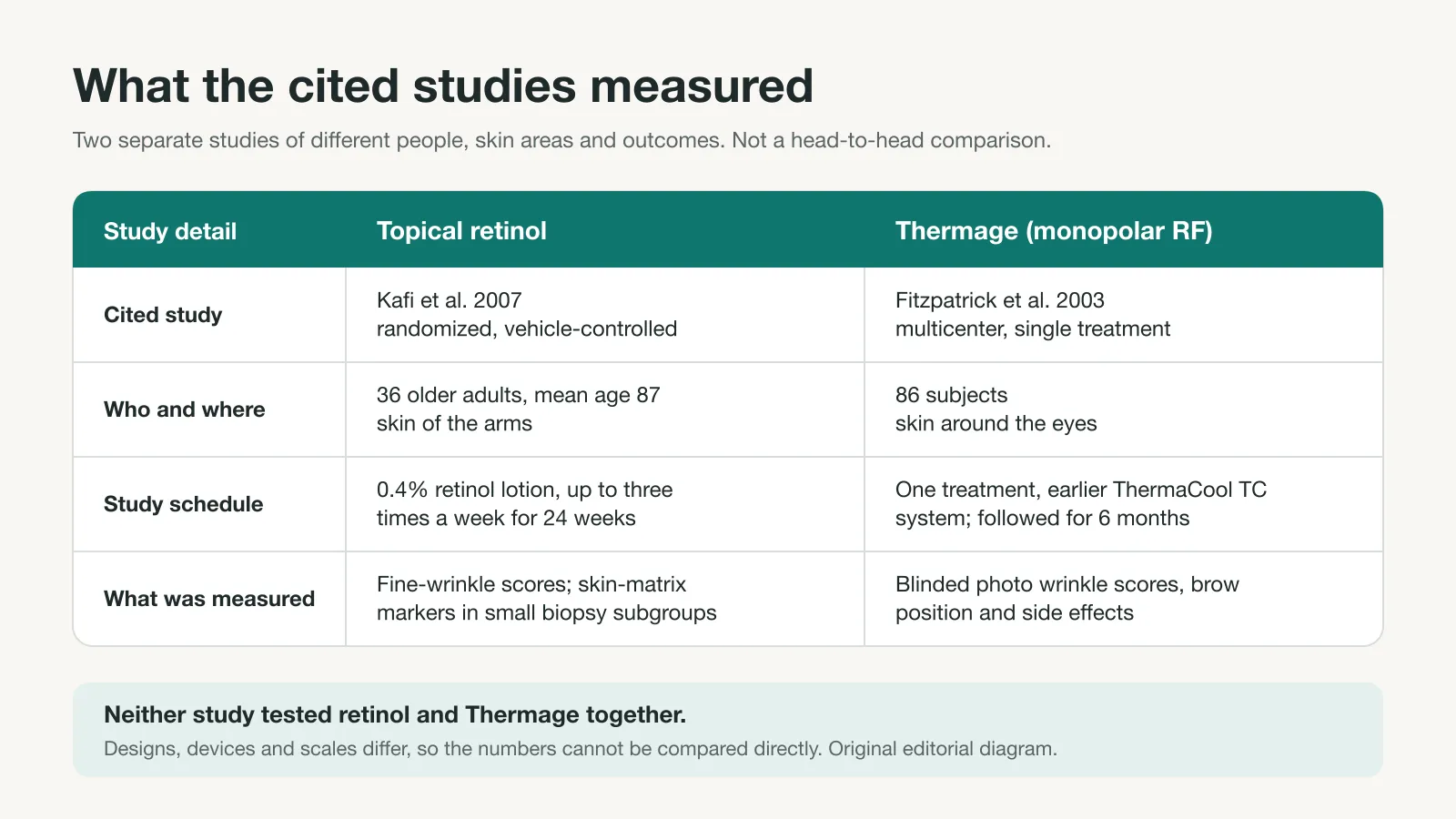
This guide compares them on three points: how each is used, what the cited studies measured, and what the evidence leaves open.
How each one is used
Retinol is vitamin A in its alcohol form. It belongs to the retinoid family, which also includes retinaldehyde, tretinoin (all-trans retinoic acid) and synthetic retinoids. A 2006 review of retinoids in skin aging notes that retinol has been used in over-the-counter cosmetic products since 1984, that the skin must convert it to retinoic acid before it acts, and that it is less potent than tretinoin, citing earlier studies that observed roughly a 20-fold difference. That figure does not set equivalent product strengths or predict wrinkle effects. Retinol also degrades in light and air, so the formulation affects what actually reaches the skin.
Thermage FLX is a monopolar capacitive radiofrequency system made by Solta Medical, a Bausch Health company, and a clinician delivers it in a session. FDA's K170758 summary describes 6.78 MHz RF energy delivered through a disposable treatment tip while the system conductively cools the epidermis and monitors skin contact. As the guide to what Thermage is explains, it produces a broad heating field through the dermis rather than one fixed focal point.
What retinol changed in a controlled trial
Kafi and colleagues at the University of Michigan ran a randomized, double-blind, vehicle-controlled trial in 36 older adults with a mean age of 87, living in two senior residences. Study staff applied 0.4% retinol lotion to one arm and the vehicle lotion to the other, up to three times a week for 24 weeks. That was a research protocol, not a routine to copy.
On a 0 to 9 severity scale, fine-wrinkling scores fell by 1.64 points on the retinol-treated arms and by 0.08 points with the vehicle. In small biopsy subgroups, retinol increased glycosaminoglycan expression (six people) and procollagen I staining (four people) compared with the vehicle. The authors concluded that more glycosaminoglycan, which holds water, and more collagen production were the most likely reasons for the smoother skin.
The limits matter for a facial decision. This was naturally aged arm skin, not facial skin in younger adults, and the trial measured fine wrinkles, not loose or sagging tissue.
The review describes how topical retinoids work more broadly: they increase epidermal growth and thickness, make the outer horny layer more compact and increase glycosaminoglycan deposits. In the tretinoin studies it summarizes, new collagen formed in the papillary dermis, the upper part of the dermis, and trials reported improvement in fine wrinkling, mottled pigmentation and roughness over months of use. Most of that work concerned photoaged skin and tretinoin, which the review calls the most potent and most widely investigated retinoid, so it does not transfer one to one to an over-the-counter retinol.
What Thermage changed in a multicenter study
Fitzpatrick and colleagues followed 86 subjects for six months after a single periorbital treatment with the ThermaCool TC System, an earlier Thermage generation. Independent reviewers scoring blinded photographs found at least a one-point improvement on the Fitzpatrick wrinkle scale in 83.2% of treated periorbital areas (99 of 119). Treating physicians, assessing without the pre-treatment photographs, noted improvement in 28.9% of areas (48 of 166), and 50% of participants (41 of 82) said they were satisfied or very satisfied with the wrinkle change. Photographic measurement showed at least 0.5 mm of brow lift in 61.5% of eyebrows (40 of 65).
The study also reported second-degree burns in 0.36% of RF applications (21 of 5,858) and small areas of residual scarring in three people at six months. The authors read the pattern as early tightening from heat, followed by further tightening on a timescale consistent with thermal wound healing.
The RF study has different limitations. It studied one area with an older device and included no retinol or skincare comparison, and the gap between blinded photo scores, physician impressions and satisfaction shows how much the chosen measure shapes the headline number. It followed participants for six months, so it does not establish how long any change lasts beyond that. Thermage is not permanent.
What the US device records cover
FDA's 510(k) database lists K021402, decided November 5, 2002, for the ThermaCool TC System. It covers electrocoagulation and hemostasis and the non-invasive treatment of periorbital wrinkles and rhytids, which the summary describes as an expanded indication. K170758, decided September 22, 2017, lists the RF-energy components of Thermage FLX for the same surgical uses, for periorbital wrinkles including the upper and lower eyelids, and for wrinkles and rhytids.
A 510(k) clearance means FDA found the device substantially equivalent to legally marketed devices for those listed uses. It says nothing about retinol, and it does not compare a device with skincare.
Where each one stops
Retinol's cited benefits came from months of repeated use, and it has its own side effects. The review describes a "retinoid reaction" of itching, burning, redness and peeling, usually in the first few weeks, and early sensitivity to sunlight. It reports the reaction as more common with tretinoin and tazarotene than with retinol or retinaldehyde. The same review advises caution with retinoids around pregnancy.
Thermage is a clinic procedure with its own safety labeling. Solta Medical's important safety information lists implanted electrical devices, such as pacemakers and implantable cardioverter-defibrillators, as a contraindication, and says Solta has not studied use during pregnancy or breastfeeding. Its reported adverse reactions include blisters, burns and scarring. Metal near the treatment area, including dental work, is something to disclose so the clinician can assess precautions; the technical manual for the earlier Thermage CPT system advises caution when treating directly over metal dental work because RF can heat the metal. The candidates guide covers who it suits.
Neither was tested against the other in the studies cited here, and no cited study tested them together. Sun protection is relevant to both. The review advises it for people using a retinoid, especially early on, and this site's aftercare guide lists it first among the habits for the months after a session.
Start a retinoid, book Thermage, or plan both
A practical way to frame the decision is to name the change you most want, then match it to what each option was studied for. These are questions to bring to a consultation, not a replacement for one.
- Mostly surface concerns. Fine lines, rough texture or uneven tone are closest to what the retinoid studies measured. Whether a retinoid suits your skin, and whether a stronger or prescription product is appropriate, is a question for a clinician.
- Mostly looseness. Mild laxity around the eyes and brow is closest to what the cited Thermage study measured; other areas were not part of it. This site describes Thermage as suited to mild-to-moderate dermal laxity confirmed on examination, and more marked laxity may need a different approach.
- Both. The cited studies do not establish whether one can substitute for the other or whether combining them improves outcomes, because none measured the pair. If you plan both, the treating clinician sets the order.
When to pause or restart a retinoid around a session is a timing question, and this guide does not answer it. The aftercare and downtime guide covers skincare in the first week after a session, and the Thermage timing questions page explains how sequencing around other treatments and pregnancy is decided. Bring the name and strength of every retinoid you use, topical or oral, to the consultation. Irritation, pregnancy and prescription questions belong with a clinician.
Delight Dermatology's Thermage consultation overview describes its examination-led process. This guide does not recommend a retinoid product or strength.
Common questions
- Is retinol a substitute for Thermage?
- The cited studies do not establish whether one can substitute for the other. The retinol trial measured fine wrinkling and skin-matrix markers on aged arm skin over 24 weeks. The Thermage study measured periorbital wrinkle scores and brow position after one treatment with an earlier system. Neither study compared the two.
- Can retinol and Thermage be part of the same plan?
- None of the sources cited here tested retinol and Thermage together, so they do not establish whether combining them improves outcomes. Whether to combine them, and in what order, depends on the skin, the product and the treatment plan, so the treating clinician decides.
- Which lasts longer, retinol or Thermage?
- No source cited here compared durability. The retinoid review describes tretinoin's benefits as appearing slowly, over a long period of use. The cited Thermage study followed participants for six months and does not establish how long results last beyond that, and Thermage is not permanent.
Sources
- Kafi R, et al. Improvement of naturally aged skin with vitamin A (retinol). Archives of Dermatology, 2007;143(5):606-612. PMID 17515510.
- Mukherjee S, et al. Retinoids in the treatment of skin aging: an overview of clinical efficacy and safety. Clinical Interventions in Aging, 2006;1(4):327-348. PMID 18046911.
- Fitzpatrick R, et al. Multicenter study of noninvasive radiofrequency for periorbital tissue tightening. Lasers in Surgery and Medicine, 2003;33(4):232-242. PMID 14571447.
- FDA K021402: Thermage ThermaCool TC System, 510(k) record, decision November 5, 2002.
- FDA K170758: Thermage FLX System, decision and 510(k) summary, decision September 22, 2017.
- Solta Medical. Thermage CPT/FLX System important safety information, healthcare professional page, checked October 17, 2026.
- Solta Medical. Thermage CPT System technical user's manual, P009240-06, September 2021.