How the sessions were run
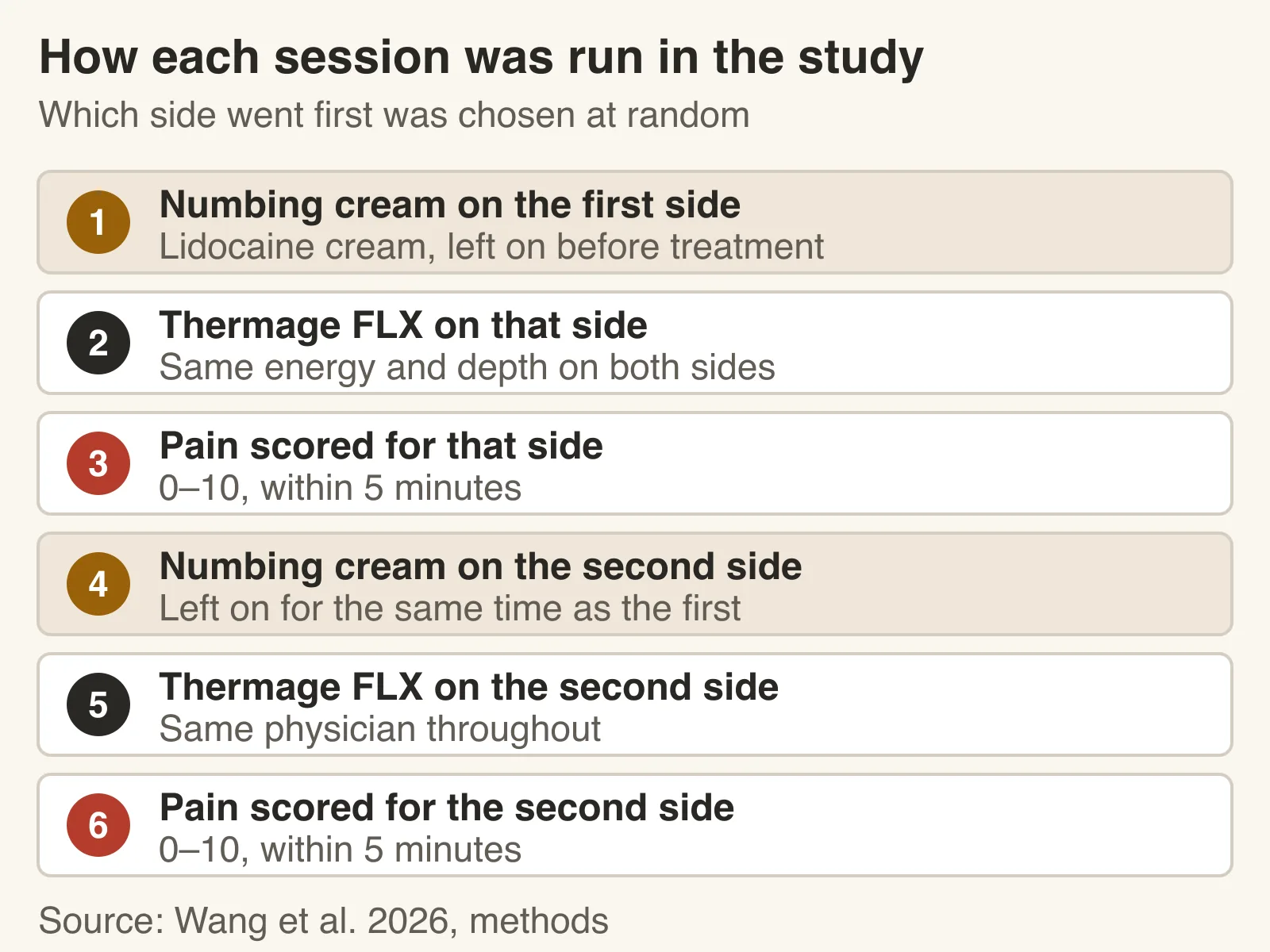
Wang and colleagues at the Plastic Surgery Hospital of the Chinese Academy of Medical Sciences in Beijing enrolled 46 people with facial laxity, 45 women and one man aged 30 to 58, and treated both sides of the face with Thermage FLX in one session. A computer chose at random which side went first, and one right-handed physician with more than ten years of radiofrequency experience treated everyone.
The first side was covered with lidocaine numbing cream and then treated; the second side was numbed the same way, for the same time, and treated next. Energy, depth and treatment time were matched on both sides. Within five minutes of finishing each side, participants marked their pain on a 0–10 visual analog scale in steps of 0.1.
Scores by side of the face and by age
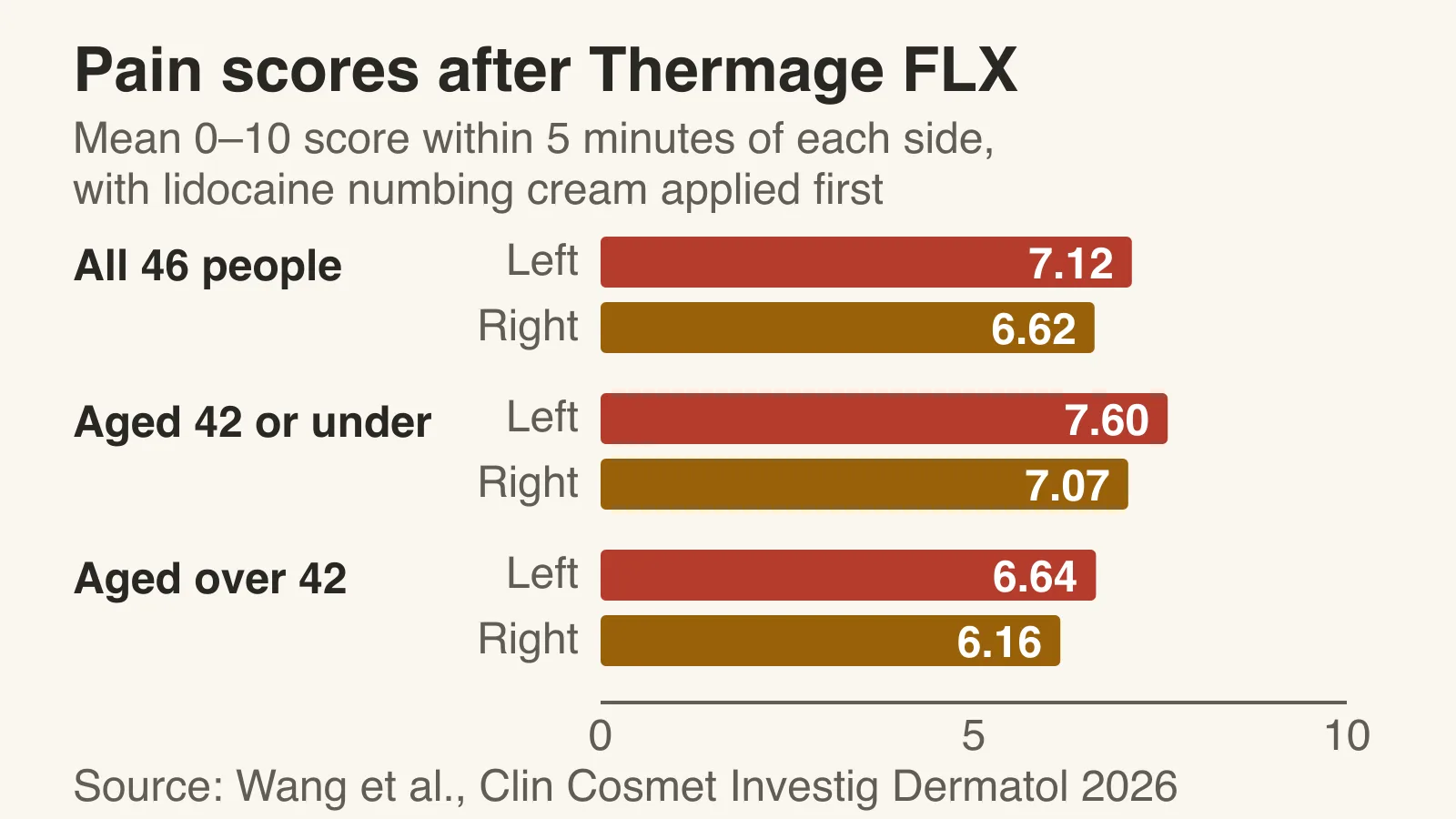
The left side averaged 7.12 and the right 6.62, a difference that held whichever side was treated first. Splitting the group at the median age of 42, the 23 people aged 42 or under scored 7.60 on the left and 7.07 on the right, and the 23 people over 42 scored 6.64 and 6.16. Older age went with lower scores across the whole group. People whose left side was treated first reported lower overall pain than those who started on the right.
The authors link the left-side difference to the way the right half of the brain processes pain, and suggest that younger patients may need more pain relief planned in advance, such as topical anesthesia, painkillers taken before treatment or psychological support. Every participant had the cream, so the study shows how sessions scored with numbing in place; it did not compare sessions with and without cream. It was a single-center study in which 45 of the 46 participants were women.
What the Thermage FLX record describes during treatment
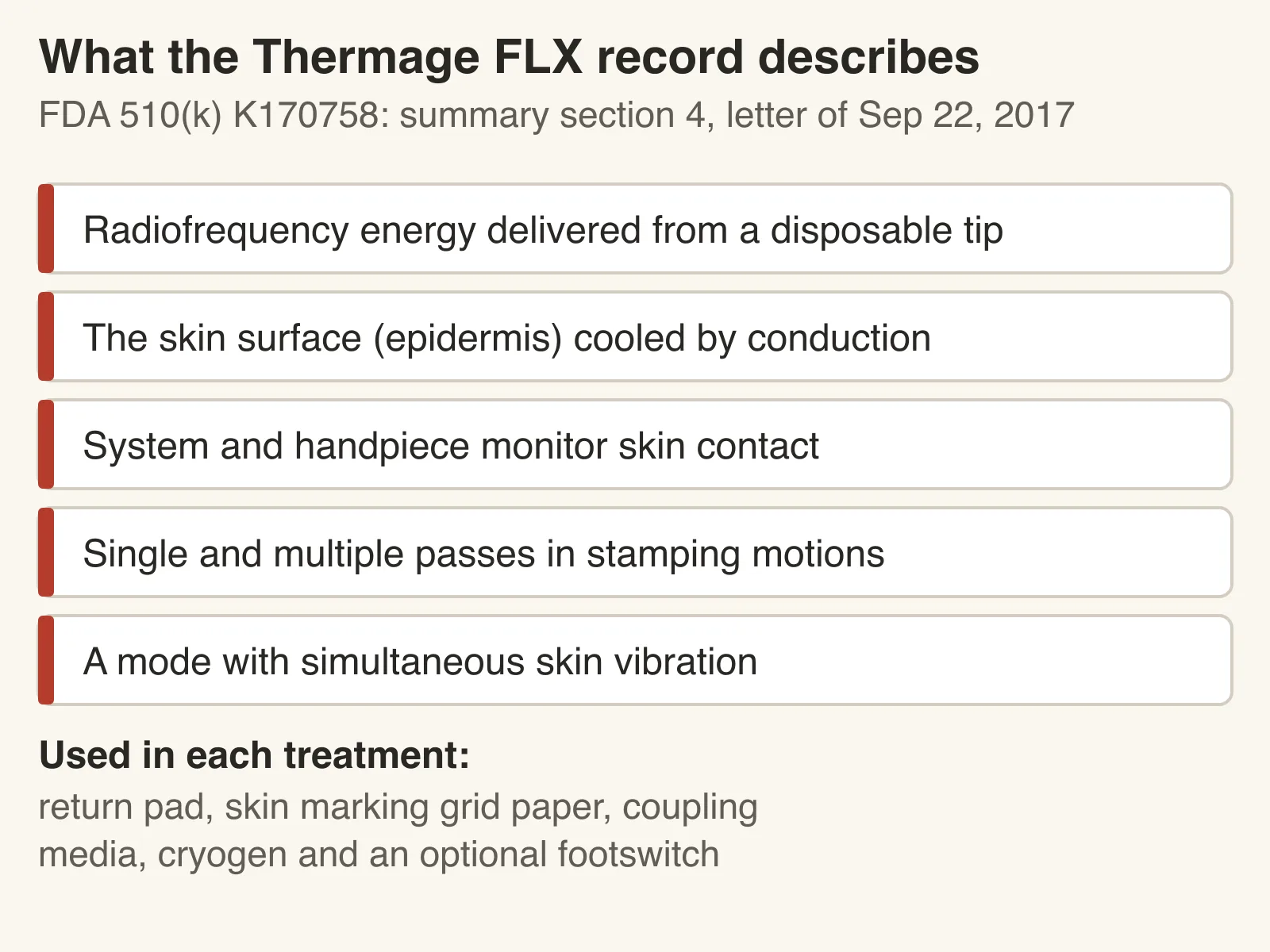
The 510(k) summary in record K170758, whose FDA letter is dated September 22, 2017, describes a system that delivers radiofrequency energy from a disposable tip while cooling the skin surface by conduction. The system and handpiece monitor skin contact, energy is delivered in single and multiple passes of stamping motions, and the record lists a mode that applies radiofrequency energy and skin vibration at the same time. Cryogen is among the accessories used in each treatment. How the treatment works is covered in what Thermage is.
What to agree before your session
- Will numbing cream be used, for how long, and on one side at a time or the whole face at once?
- Can the settings be adjusted, or a pause taken, if one area is too uncomfortable?
- Which areas are planned, and roughly how long will each side take?
- Whom do I contact if discomfort, swelling or redness lasts longer than expected?
For the order of a session at one Seoul clinic, from consultation to aftercare, see the Thermage steps listed by Delight Dermatology Clinic. The days after treatment are covered in the aftercare and downtime guide.
Common questions
- How painful is Thermage on a 0 to 10 scale?
- In a 2026 study of 46 people treated with Thermage FLX on both sides of the face, the mean pain score was 7.12 for the left side and 6.62 for the right, recorded within five minutes of finishing each side. Every side had been numbed with lidocaine cream first.
- Is one side of the face more painful during Thermage?
- In that study the left side scored higher than the right whichever side was treated first. The same physician treated everyone, with the energy, depth and treatment time matched on both sides.
- Do younger people feel more pain with Thermage?
- Participants aged 42 or under scored higher than those over 42: 7.60 against 6.64 on the left side and 7.07 against 6.16 on the right. Across the group, older age went with lower scores.
Published references
- Wang Y, et al. Evaluation of the effect of laterality and age on pain perception in monopolar radiofrequency facial therapy. Clinical, Cosmetic and Investigational Dermatology, 2026;19:577283. PMID 41924292.
- FDA 510(k) K170758: Thermage FLX System, letter, indications for use and 510(k) summary, letter dated September 22, 2017.