Two kinds of radiofrequency
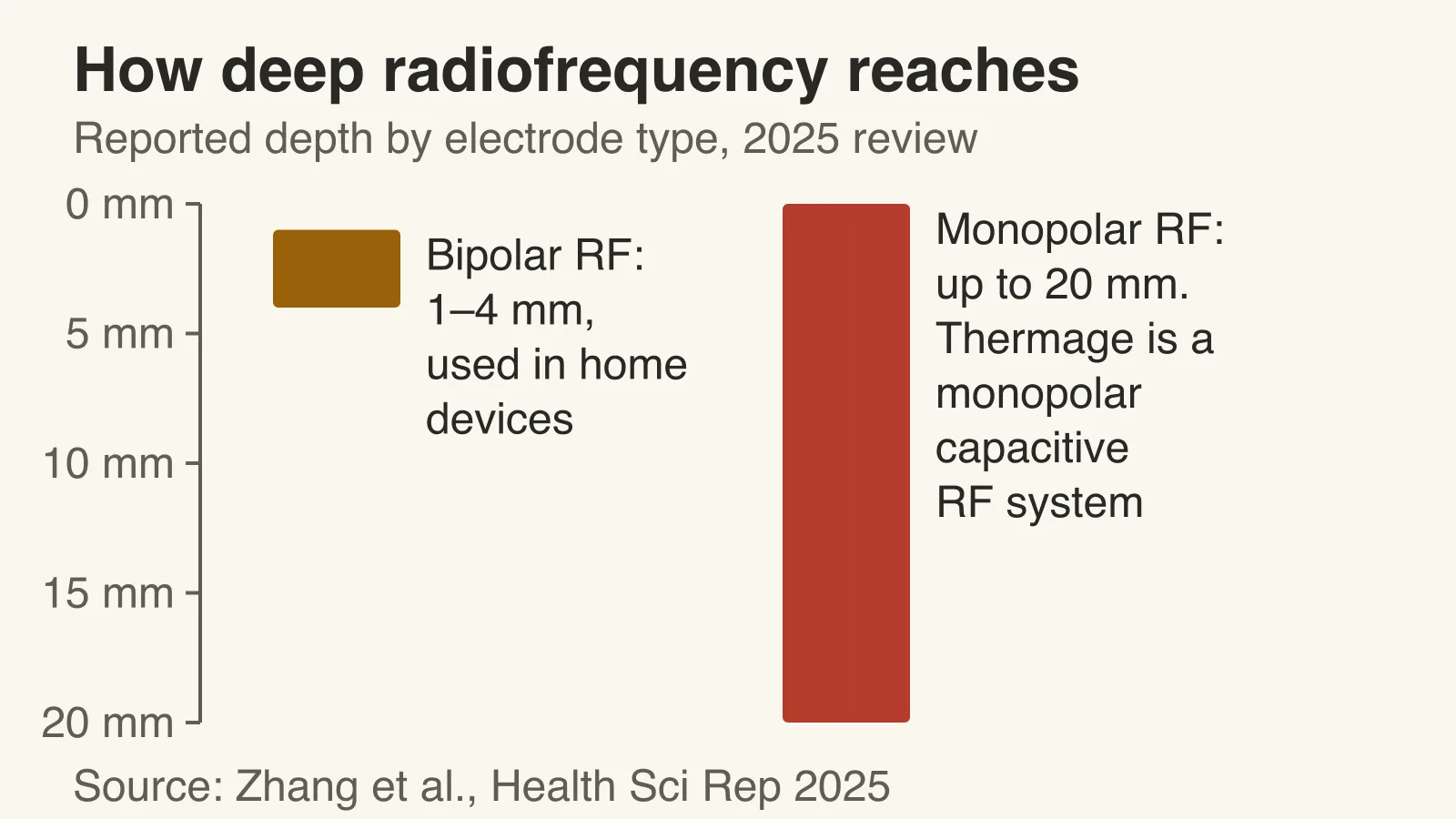
Radiofrequency heats the dermis, which tightens collagen and starts new collagen formation. A 2025 review of radiofrequency for skin rejuvenation describes monopolar devices as reaching up to 20 mm, with energy that has to be carefully controlled to limit discomfort, and bipolar devices as reaching 1–4 mm, which the authors say makes home use safer.
Thermage is a monopolar capacitive system. The 510(k) summary in record K170758, whose FDA letter is dated September 22, 2017, lists a 6.78 MHz output and a maximum average power of 400 W, cooling of the skin surface during delivery, and among its indications the non-invasive treatment of wrinkles and rhytids, including around the eyes. The home device tested in a 2022 trial used a 1 MHz bipolar ring electrode with red light and held the skin at 37–42 °C, cutting the output when the skin got too warm or the device stayed still.
How a 2026 review graded home devices
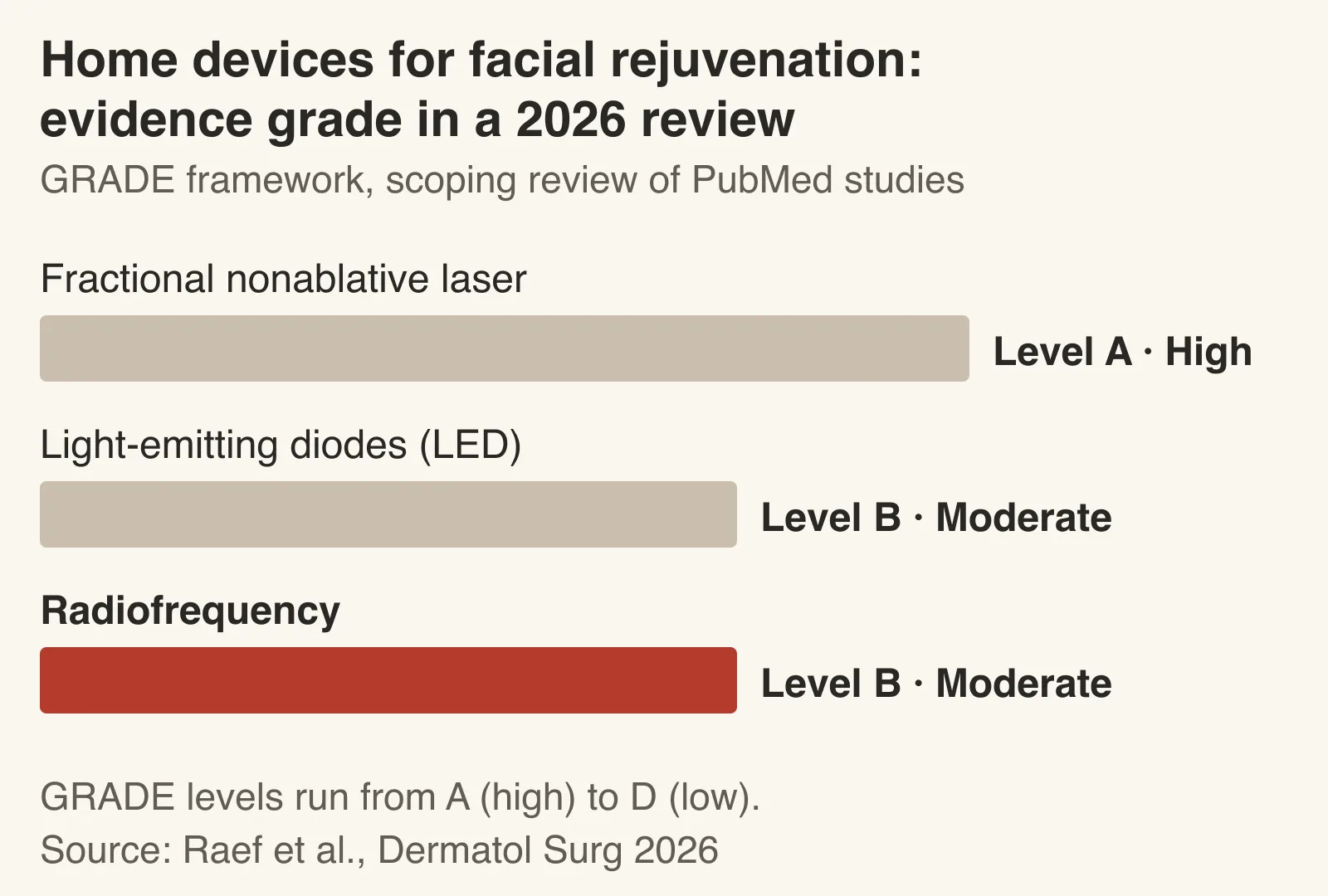
Raef and colleagues, writing in Dermatologic Surgery in August 2026, searched PubMed for clinical studies of home devices for acne and facial rejuvenation and graded the evidence with the GRADE framework. For rejuvenation, home fractional nonablative lasers reached high-quality evidence (Level A), and light-emitting diodes and radiofrequency devices moderate evidence (Level B).
What the home-use trials measured
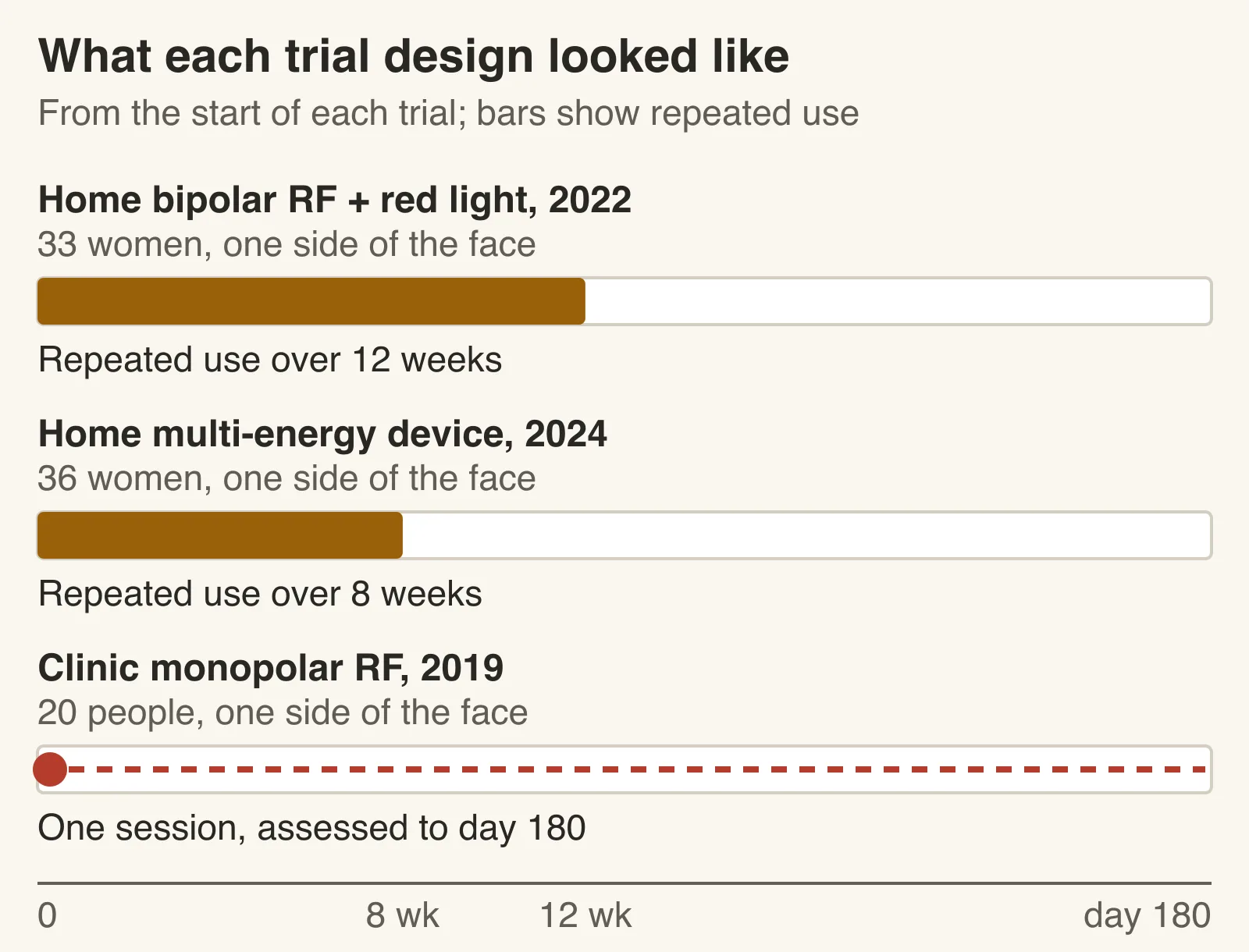
In a randomized split-face trial from Chengdu, 33 women used a home bipolar radiofrequency device with gel on one side of the face and an anti-aging cosmetic on the other, under supervision at the study center, over 12 weeks; 32 finished. The device side improved more in crow's-feet roughness, radiance, skin color and skin thickness, while hydration rose on both sides with no difference between them. No adverse reactions were seen, and participants knew which side was which.
A 2024 Korean split-face trial gave 36 women a handheld home device that emits low-level light, low-dose radiofrequency, microcurrent and low-intensity ultrasound together. After 8 weeks, hydration, elasticity, roughness, pore size and the volume of wrinkles around the eyes had improved against baseline and the control side, biopsies showed more type 1 collagen, and no adverse effects were observed.
What a clinic monopolar study measured
In a 2019 split-face trial, 20 people with mild to moderate laxity had monopolar capacitive radiofrequency on one side of the face in a single session. Laxity scores for the face and upper neck had improved significantly by day 30 and stayed improved at days 90 and 180. How a clinic session heats the skin is described in what Thermage is.
Questions that decide between them
- Is the change you want in fine lines, texture and hydration, the endpoints of the home trials, or in laxity, the endpoint of the clinic study?
- Will you use a device repeatedly for two to three months, as people did in the home trials?
Who should not have Thermage is covered in candidates and contraindications. For what an in-clinic session involves, see Thermage FLX at Delight Dermatology Clinic.
Common questions
- Can an at-home RF device replace Thermage?
- The two home-device trials cited here measured wrinkles, hydration, radiance and elasticity after 8 to 12 weeks of repeated use against a cosmetic or a control side. A clinic monopolar radiofrequency trial measured facial laxity for six months after one session. None of these trials compared a home device with Thermage directly.
- Is at-home radio frequency skin tightening safe?
- Neither home-device trial reported adverse reactions. A 2026 review in Dermatologic Surgery rated the evidence for home radiofrequency devices as moderate (Level B) and placed them, with fractional lasers and light-emitting diodes, among the home devices with the most favorable balance of efficacy and safety.
Published references
- Raef HS, et al. Home-based dermatologic devices for acne and rejuvenation: evidence-based insights. Dermatologic Surgery, published online August 4, 2026. PMID 42545315.
- Zhang B, et al. The landscape of radiofrequency technology for skin rejuvenation. Health Science Reports, 2025;9(1):e71575. PMID 41467235.
- Shu X, et al. Effectiveness of a radiofrequency device for rejuvenation of aged skin at home: a randomized split-face clinical trial. Dermatology and Therapy, 2022;12(4):871-883. PMID 35249173.
- Choi S, et al. Efficacy and safety of a home-use handheld multi-energy-based device for skin rejuvenation: clinical, ex vivo, and histological studies. Lasers in Medical Science, 2024;39(1):38. PMID 38236440.
- Alhaddad M, et al. A randomized, split-face, evaluator-blind clinical trial comparing monopolar radiofrequency versus microfocused ultrasound with visualization for lifting and tightening of the face and upper neck. Dermatologic Surgery, 2019;45(1):131-139. PMID 30531187.
- FDA 510(k) K170758: Thermage FLX System, letter, indications for use and 510(k) summary, letter dated September 22, 2017.